Note: The media and content of this case study is best viewed on desktop.

Progress That Motivates

Cerebral

6 months

Product

Cerebral

Comprehensive, evidence-based mental health care

Snapshot

Surface: Desktop & Mobile

Role: Product Designer

Team: PM, Eng, Data/Analytics, Research, Clinical Operations, Brand

Scope: End-to-end assessments experience

Northstar: Increase 1st time insurance patient attendance rates

Baseline: 1% page visit rate, 40% assessment completion rate

TL;DR

Motivation Drop

New Cerebral insurance patients weren’t attending their 1st sessions representing decreased engagement which we attributed to lower motivation

Progress Reimagined

I led strategy + design to evolve the Assessments page into a progress experience: clear meaning, personalized guidance, and next steps.

Measured Lift

Launched as an A/B test with improvements in CSAT, assessment completion and visit attendance.

Product

Cerebral

Comprehensive, evidence-based mental health care

Snapshot

Surface: Desktop & Mobile

Role: Product Designer

Team: PM, Eng, Data/Analytics, Research, Clinical Operations, Brand

Scope: End-to-end assessments experience

Northstar: Increase 1st time insurance patient attendance rates

Baseline: 1% page visit rate, 40% assessment completion rate

TL;DR

Motivation Drop

New Cerebral insurance patients weren’t attending their 1st sessions representing decreased engagement which we attributed to lower motivation

Progress Reimagined

I led strategy + design to evolve the Assessments page into a progress experience: clear meaning, personalized guidance, and next steps.

Measured Lift

Launched as an A/B test with improvements in CSAT, assessment completion and visit attendance.

Context

Context

Context

Staying motivated to attend therapy can be hard.

Even when care is working, patients can experience uncertainty:

  • Am I improving? What does this score mean?

  • What should I do next?

Cerebral already had an assessments progress page, but the experience wasn’t translating into clarity or motivation.

Even when care is working, patients can experience uncertainty:

  • Am I improving? What does this score mean?

  • What should I do next?

Cerebral already had an assessments progress page, but the experience wasn’t translating into clarity or motivation.

Even when care is working, patients can experience uncertainty:

  • Am I improving? What does this score mean?

  • What should I do next?

Cerebral already had an assessments progress page, but the experience wasn’t translating into clarity or motivation.

Problem

Problem

Problem

The assessments page was a dead end — with only 1% return visit rate and 40% assessment completion rates.

Why this matters

  • If patients can't understand their progress or potential value of their progress, they're less likely to stay engaged and follow through with their care plan

  • This means lower attendance, retention and patient outcomes over time

ORIGINAL CEREBRAL ASSESSMENTS PAGE

Research Findings

Research Findings

Research Findings

Our research found patients didn't find value in the Assessments page because:

  1. It wasn't clear how assessments benefitted them

  2. They couldn't connect scores to their broader journey at Cerebral

Patient feedback highlights

"What does this information mean? Is a higher score better or worse?"

Patient interviews

In-product feedback

Patient 1

Clarity

"Not at all engaging. I don’t know what I’m looking at or what happened vs my start date."

Survey results

In-product feedback

Patient 2

Value

“Who is this page for? What am I supposed to do now?”

Screen replay

In-product feedback

Patient 3

Actionability

"“I need a way to help me track what’s normal for me and share variations with my prescriber.”

Clinical team notes

In-product feedback

Patient 4

Effectiveness

Goal

Goal

Goal

How might we…

help members understand where they are in their mental health journey so they feel motivated to continue care?

Success Criteria
  • Short-term:

    • Page CSAT

    • Assessment completion rate

    • Repeat page visit rate

  • Medium-term:

    • Session completion rate

Success Criteria
  • Short-term:

    • Page CSAT

    • Assessment completion rate

    • Repeat page visit rate

  • Medium-term:

    • Session completion rate

Success Criteria
  • Short-term:

    • Page CSAT

    • Assessment completion rate

    • Repeat page visit rate

  • Medium-term:

    • Session completion rate

Key Constraints

  • Limited time: the feature needed to fit into max 3 sprints worth of work (6 weeks)

  • Limited backend eng capacity due to a competing project

  • Needed to seamlessly transition to new design system while building

Key Constraints

  • Limited time: the feature needed to fit into max 3 sprints worth of work (6 weeks)

  • Limited backend eng capacity due to a competing project

  • Needed to seamlessly transition to new design system while building

Key Constraints

  • Limited time: the feature needed to fit into max 3 sprints worth of work (6 weeks)

  • Limited backend eng capacity due to a competing project

  • Needed to seamlessly transition to new design system while building

What I Owned

  • Experience strategy, information architecture and interaction design

  • Collaboration with all product stakeholders to align on principles, constraints and solutions

  • Alignment and approvals from clinical and operations stakeholders to ensure compliance with legal directives

What I Owned

  • Experience strategy, information architecture and interaction design

  • Collaboration with all product stakeholders to align on principles, constraints and solutions

  • Alignment and approvals from clinical and operations stakeholders to ensure compliance with legal directives

What I Owned

  • Experience strategy, information architecture and interaction design

  • Collaboration with all product stakeholders to align on principles, constraints and solutions

  • Alignment and approvals from clinical and operations stakeholders to ensure compliance with legal directives

Strategy

Strategy

Strategy

I ran a collaborative strategy + design session anchored on 3 principles:

01 Personalized guidance

Make it feel like my journey

02 Simplicity

Reduce cognitive load; make it intuitive

03 Actionability

Always provide a next step

I treated this like a behavioral psychology problem. Introducing guidance and clarity could lead to

motivation.

Explorations

Explorations

Explorations

I explored several directions before landing on the final experience.

Trade-offs important decisions.

01

Insight vs Info Overload

Show progress trends without turning the page into a clinical dashboard of your business, forming the foundation for an impactful strategy.

02

Personalization without clinical advice

Provide actionable guidance without crossing into “medical advice” territory.

03

Supportive motivation vs pressure

Encourage completion without making users feel pressured into not having good progress or not reaching specific milestones

Design Explorations

I conducted research on how other apps show and encourage progress and brainstormed ideas with the team

A More Discoverable Entry Point
  • Field 1 Example
  • Field 2 Example
  • Field 3 Example

Reflections

I conducted research on how other apps show and encourage progress and brainstormed ideas with the team

Observations

  • PHQ-9 and GAD-7 remain the key way companies measure and demonstrate mental health progress, but the average person doesn't know what they really are

  • Some do try to show increased or decreased progress, but not next steps, guidance or assurance

  • None make it very easy to share thoughts/concerns with clinicians based on results

Observations

  • PHQ-9 and GAD-7 remain the key way companies measure and demonstrate mental health progress, but the average person doesn't know what they really are

  • Some do try to show increased or decreased progress, but not next steps, guidance or assurance

  • None make it very easy to share thoughts/concerns with clinicians based on results

Assesment completion rates increased

+12%

+1%

+1%

Higher Session Attendance

More people showed up for their next session

4.8 CSAT

Customer satisfaction out of 5

Design Explorations

I conducted research on how other apps show and encourage progress and brainstormed ideas with the team

A More Discoverable Entry Point
  • Field 1 Example
  • Field 2 Example
  • Field 3 Example

Reflections

I conducted research on how other apps show and encourage progress and brainstormed ideas with the team

Observations

  • PHQ-9 and GAD-7 remain the key way companies measure and demonstrate mental health progress, but the average person doesn't know what they really are

  • Some do try to show increased or decreased progress, but not next steps, guidance or assurance

  • None make it very easy to share thoughts/concerns with clinicians based on results

Observations

  • PHQ-9 and GAD-7 remain the key way companies measure and demonstrate mental health progress, but the average person doesn't know what they really are

  • Some do try to show increased or decreased progress, but not next steps, guidance or assurance

  • None make it very easy to share thoughts/concerns with clinicians based on results

Assesment completion rates increased

+12%

+1%

+1%

Higher Session Attendance

More people showed up for their next session

4.8 CSAT

Customer satisfaction out of 5

Design Explorations

I conducted research on how other apps show and encourage progress and brainstormed ideas with the team

A More Discoverable Entry Point
  • Field 1 Example
  • Field 2 Example
  • Field 3 Example

Reflections

I conducted research on how other apps show and encourage progress and brainstormed ideas with the team

Observations

  • PHQ-9 and GAD-7 remain the key way companies measure and demonstrate mental health progress, but the average person doesn't know what they really are

  • Some do try to show increased or decreased progress, but not next steps, guidance or assurance

  • None make it very easy to share thoughts/concerns with clinicians based on results

Observations

  • PHQ-9 and GAD-7 remain the key way companies measure and demonstrate mental health progress, but the average person doesn't know what they really are

  • Some do try to show increased or decreased progress, but not next steps, guidance or assurance

  • None make it very easy to share thoughts/concerns with clinicians based on results

Assesment completion rates increased

+12%

+1%

+1%

Higher Session Attendance

More people showed up for their next session

4.8 CSAT

Customer satisfaction out of 5

Solution

Solution

Solution

Reframe Assessments into Progress

Instead of a page that displays scores, the new progress experience provides a clear, personalized plan.

A More Discoverable Entry Point

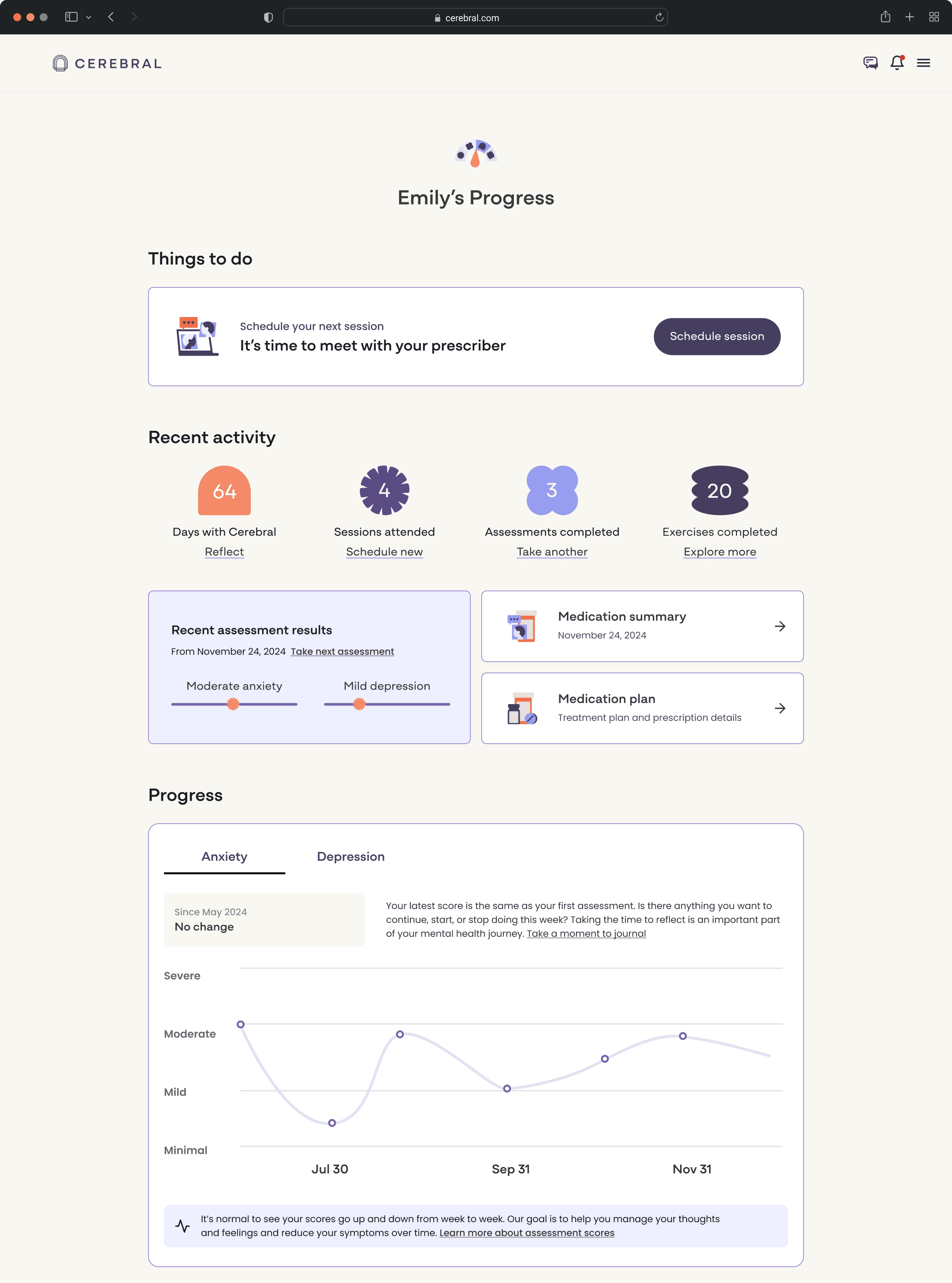
A redesigned surface that guides patients naturally into the Progress Page from multiple touchpoints. Clear placement and consistent navigation make progress feel central, not hidden.

Personalized Next Steps

Smart prompts surface the most important actions a patient should take next—like scheduling a session, completing an assessment, or renewing a prescription.

Actionable Assessment Results

A detailed view of anxiety and depression trends shows score history, baseline comparisons, and microcopy that explains what changes mean and how to move forward without fear.

Reflection & Communication Tools

Patients can journal about their wellbeing, track mood, and message their clinician directly, with curated resources that support ongoing growth between sessions.

Impact

Impact

Impact

The redesigned page gives patients clearer guidance and a stronger sense of direction, resulting in higher engagement.

Assesment completion rates increased

+0%

+0%

+0%

+0%

Higher session attendance

Customer satisfaction score

+0.0%

+0.0%

Final Experience

Final Experience

Final Experience

Discovering and going through the new progress page experience

  • Patients see their score history, understand it in plain English, and know exactly what comes next in their treatment

  • Reframes assessments from “clinical tasks” to motivational progress checkpoints

  • Creates continuity rather than drop-off

Onboarding Patients Into the Updated Flow

Patients now encounter the redesigned Progress Page at natural milestones. Rather than a static screen, it becomes a living part of their care loop.

  • As new users to the platform

  • Email entry point after sessions

  • From push notification reminders

Onboarding Patients Into the Updated Flow

Patients now encounter the redesigned Progress Page at natural milestones. Rather than a static screen, it becomes a living part of their care loop.

  • As new users to the platform

  • Email entry point after sessions

  • From push notification reminders

Onboarding Patients Into the Updated Flow

Patients now encounter the redesigned Progress Page at natural milestones. Rather than a static screen, it becomes a living part of their care loop.

  • As new users to the platform

  • Email entry point after sessions

  • From push notification reminders

What I learned

Re-engagement

Dead-ends are an opportunity to re-engage users.

Balance

Working under regulatory constraints demands creative problem-solving and cross-team alignment so the solution stays valuable to users while remaining compliant.

Consumer psychology

Motivation sn't always loud. It can be as simple as clarity and gentle nudges in the right direction.

Future AI Integrations

Future AI Integrations

Future AI Integrations

A natural future evolution for this project would be integrating AI across various dimensions to make the experience more insightful and personalized.
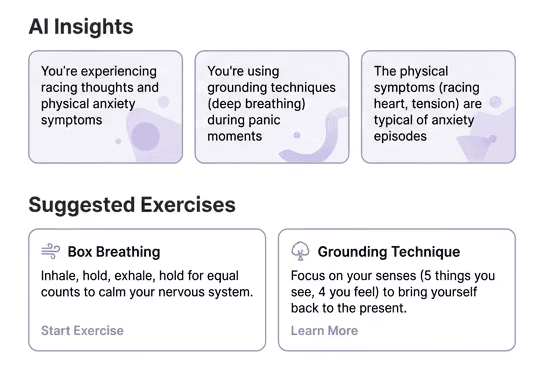
AI Journal Insights

Provide AI insights based on patient journal entries and questions
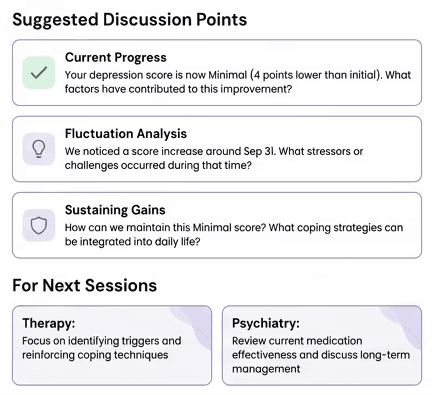
Discussion Prompts

Suggested discussion points for patients' clinicians based on their assessment results and journal entry
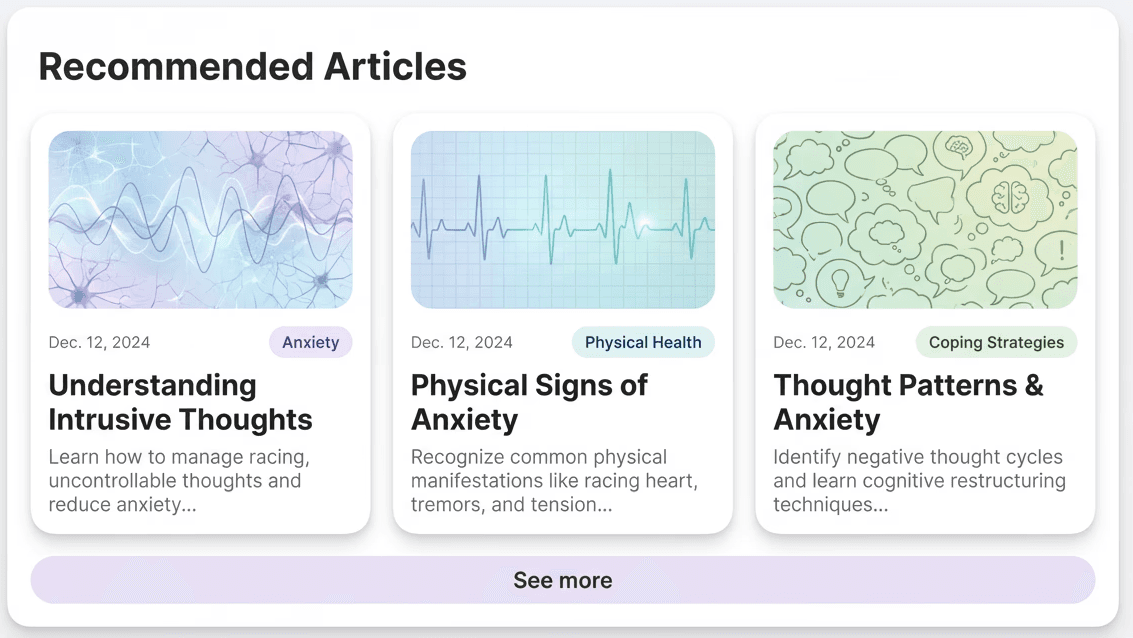
Hyperpersonalized resources

Display hyper-personalized mental health articles or content tailored to the exact symptoms and challenges patient is facing.

Prototype images created with Nano Banana Pro AI

NEXT CASE STUDY

NEXT CASE STUDY